
From the Lab Bench: AI-Powered Defect Identification
Your scans already capture the data. Now we're teaching the software to read it.
If you run a QA lab in a paper or packaging mill, you know this routine: scan a sample, count the defects, and then figure out what those defects actually are. Is that dark spot a sticky? An ink speck? A shive? The answer matters — because the fix for each one is different, and the wrong call can send your team chasing the wrong root cause.
Today, that classification step relies on the operator's eye and experience. It works — but it's slow, it varies between shifts, and it doesn't scale when you're running dozens of samples a day.
Your labs have been telling us this is a problem. We're building the solution.
What We're Building
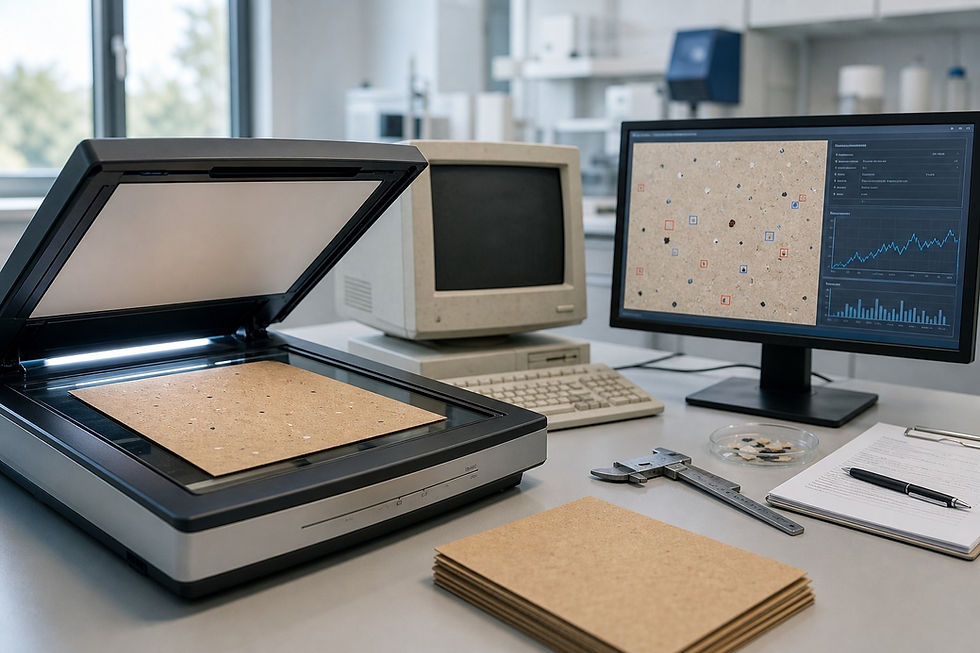
AI-powered defect identification that works directly with your Verity IA scans. The system analyzes the visual characteristics the scanner already captures — shape, contrast, color channel data, density, and edge patterns — and classifies each defect automatically.
Here's what the AI is being trained to distinguish:
Stickies & adhesive contaminants — dark, irregular, low-contrast features common in recycled furnish
Ink specks & carbon black — dark, round or oval, high-contrast — the classic "dirt" particles
Pigmented contaminants & UV brighteners — color channel anomalies that Verity IA's color extraction is uniquely suited to detect
Shives & fiber bundles — long, fibrous, low-density features easily separated by shape
Plastic film & label stock — bright white features on grey backgrounds that require RGB channel analysis
Each classification comes with a confidence score, so your team always knows when the AI is certain and when a defect needs a second look.
Why This Changes the Game
This isn't just about labeling defects faster. It's about consistency, traceability, and actionable data.
Consistent results across operators and shifts — the AI doesn't have a bad day or a different interpretation than the last tech
Root cause analysis, accelerated — when you know 73% of your defects are stickies vs. ink specks, you know where to focus your process changes
Historical trending that means something — track defect types over time, not just counts, so you can measure whether your process interventions are actually working
Faster throughput — classification happens in real time during the scan, not as a separate manual step
Built on What Verity IA Already Does Best
This feature doesn't require new hardware or a different scanning process. Your existing Epson flatbed or Contex continuous-feed scanner captures everything the AI needs. Verity IA's color extraction, contrast analysis, and shape measurement — capabilities you already use for dirt counting and stickies analysis — provide the foundation for AI classification.
We're extending what the system already sees, not asking you to change how you work.
What's Next
AI defect identification is on the development roadmap as a premium analysis module. We'll be working with select pilot mills to build and validate the training data that makes this accurate for real-world furnish and process conditions.
Interested in being part of the pilot program? We're looking for mills willing to contribute labeled scan data to help train the model. Your data stays yours — and pilot participants get early access to the finished module.
Reach out at 414-207-9899 or contact us through verityia.com.
Verity IA Systems — precision imaging and analysis for the paper, pulp, and packaging industries since 1995.


Comments